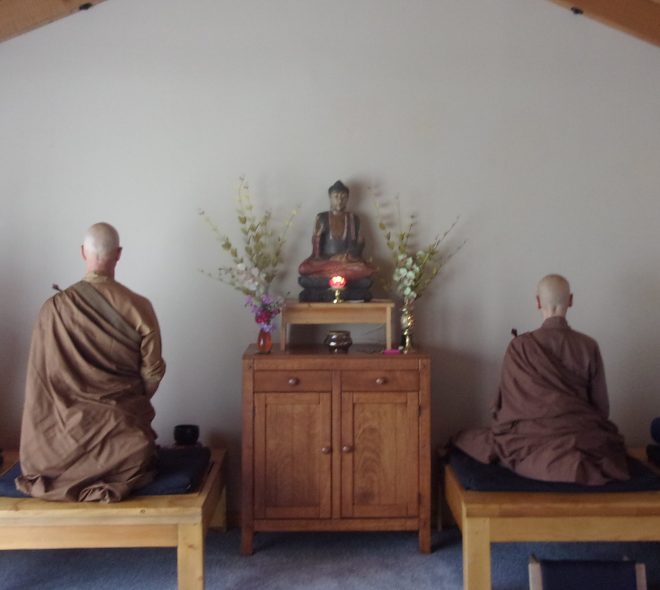
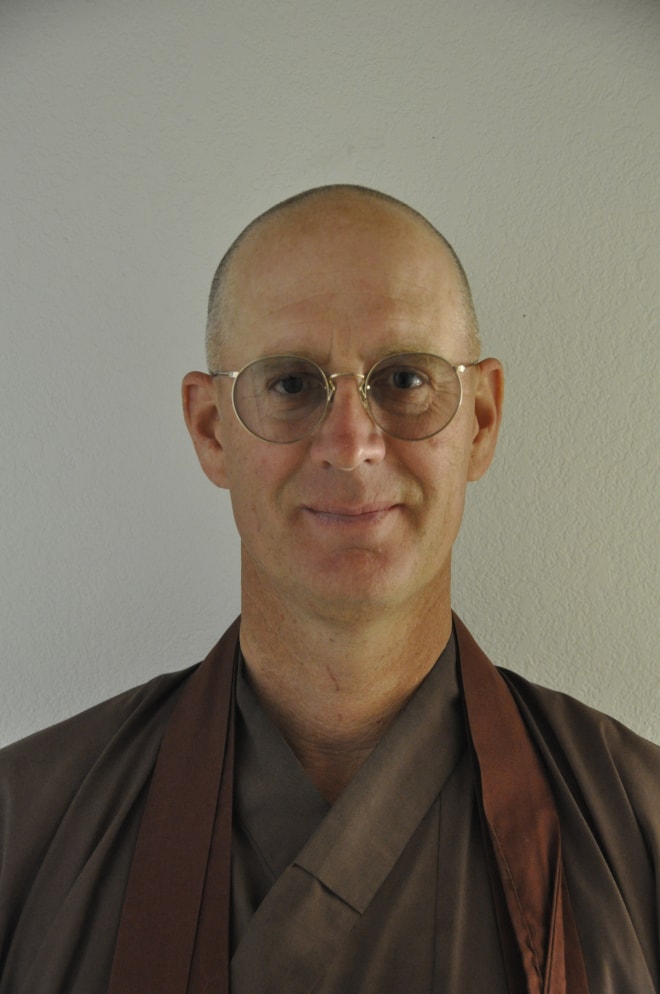
Pine Mountain Temple is a small Zen Buddhist temple and is the residence of rev. Seikai and rev. Phoebe. We offer meditation instruction and the opportunity to join us for silent meditation, Buddhist Teaching (Dharma talks), services, private talks with a monk or enjoying our meditation garden. 812 Loma Vista Place, Santa Paula, CA 93060. email: pmbt@pinemtnbuddhisttemple.
Temple is closed January 5 – 31
Starting February 1st:
Sunday: 11 am – 1 pm Chanting, Meditation, Walking Meditation and Dharma Talk.
Monday: Temple is closed.
Tuesday – Saturday: 7 – 8 am Meditation and Morning Service.
1st and 3rd Thursday of the month: 7 pm – 8:30 pm Meditation and Dharma Talk.
Next Day Retreat Saturday December 27, 2025.
Meditation Instruction 30 minutes before any event or by appointment.
In the traditional Buddhist practice of Dana we set no fixed fee for any of our offerings, and ask that you please support us by making a donation based on what you can afford. Clicking the donation button will open Paypal for you.

For more meditation locations and retreats visit:
https://venturabuddhistresource.org/
Zen inspired community living:
On Sustaining the Temple: The Practice of Dana
The first sign of enlightenment is generosity, the giving and receiving of ourselves and whatever we have to share. Temples in Buddhism are the result of the coming together of monks and lay practitioners who contribute materially and spiritually to create and maintain a place of peace, open to all who are in need.
Donations can be made in cash, as a check or through PayPal on our website, and are tax deductible.
Long term support of the temple can also take the form of a legacy or bequest.
Please contact the temple if you have time to help with any kind of work: cleaning, gardening, shopping or cooking for monks.
By Rev. Master Daizui and Rev. Master Seikai
There are a number of questions which people typically ask regarding how to meditate—in our tradition of Buddhism, that is zazen or shikantaza, translated as sitting meditation. Our teacher, Rev. Jiyu-Kennett, also employed the term serene reflection meditation. There are many ways to go about meditating, and zazen is only one of them, but at the same time the same sorts of problems seem to crop up for people regardless of what particular kind of meditation they have been taught. Rev. Daizui MacPhillamy (1946-2003) put together a booklet entitled A Perspective on the Eightfold Path, in which he included a section dealing with six of these common questions. What I am going to do here is to reprint those questions and Rev. Daizui’s answers to them. Then I will add some commentary of my own to the extent that it seems good to flesh out his answers.
- How do I know if I am doing it right?
You don’t. In fact, you can’t. That is because meditation is one with you, so there can be no separation of a “doer” and an “observer” who knows that it is right. But you can know if you aren’t (meditating), and that is all you need to know, because then you can bring yourself back to simply sitting.
Rev. Seikai: A teacher can give you instructions on how to meditate, but then you have to just do it, and that very doing is the real teacher. We all learn from experience in whatever we do, and meditation is no different. It isn’t helpful to judge your meditation as good or bad, right or wrong; sometimes it can seem easy, even effortless, and at other times it can seem next to impossible because your mind is all over the place. In either case, what we experience is subject to change, and therefore will not last indefinitely; judgment gets in the way because then what you are really doing is seeking some particular state of mind which is desirable, as opposed to another state of mind which is undesirable. In that light, the essential element of meditation is to let go of clinging to anything. Bringing yourself back to simply sitting is an act of letting go of thinking and just being there. That is really all you have to do.
- Nothing seems to be happening during meditation; what is wrong?
The problem is more likely to be with your expectations of what should “happen” than with the meditation. Meditation has profound effects over time, but the whole process is much larger than we can know and judge. Try letting go of the expectations and just sit. The same holds true if a lot is “happening.” It may help to remember that this is the practice of a lifetime: let it do its work.
Rev. Seikai: As long as you are breathing in and out, you are alive and something is happening. Similarly, your mind is always up to something as long as you are breathing and your heart is beating. In other words, no one can rightly say that nothing is happening. This means that, as Rev. Daizui says, the real problem lies with your expectations of some particular thing or state of mind that you think you should experience. More likely you are simply bored because what is happening is not exciting enough. We get bored because we are accustomed to having a lot of stimulation going on—since Rev. Daizui wrote the above, the electronic world of constant stimulation has gotten several orders of magnitude stronger and louder. Under these circumstances, people are essentially training their minds to expect a flood of stimulation from which there isn’t ever much of a break. For the average person, the real challenge is to learn to find a little bit of stillness—a capacity for awareness and acceptance—right in the midst of a world of overstimulation. It is actually enough, and it is wonderfully liberating, to just sit there and breathe in and out.
Given that most people are overstimulated mentally, and the fast pace of life has conditioned us to expect more and more, what we need to learn is patience. The practice of patience is to let go of our insistence that we should have something, or get somewhere, right now. As with any conditioned thinking or behavior, to undo it one has to observe when our expectations, our impatience, have arisen: just that simple observation of its existence arising within you is a big step. Then, with that awareness, we can choose to respond differently than our conditioning has dictated we should respond. Over time, the conditioning gets weaker and has less control over your mind. So, as Rev. Daizui says, this is the work of a lifetime and we do not have to rush it.
- How can I stop from constantly wandering off?
Don’t try to stop yourself from wandering off, because you will be trying to add something to pure meditation. But each time you are aware of having wandered off, do not waste time in coming back.
Rev. Seikai: As I said above, the mind is always up to something, and therefore we shouldn’t approach meditation with the idea that we can sit there with a mind empty of thoughts. Since for most people the mind is crowded with thoughts, which wander from one to the next without any pause the whole day through, it is natural enough to long for a quieter state of being. To cultivate that quieter state of being the way to go about it is not to do battle with your own thoughts, but rather to accept them for what they are and learn not to be ruled by them. It is also true that in that moment of realization that your mind has wandered off for the last ten minutes or more, you have just now returned to an awareness of what your mind is doing. So, to suggest that we “not waste time in coming back” is to suggest that we set the intention of returning to awareness when we have come to that moment. This intention needs to have a gentle quality to it, meaning that we do not have to beat ourselves up for having a wandering mind. Acceptance of ourselves and how our minds work is the important thing here. If your intention is to dwell within awareness, and you put gentle effort into that, your mind will adapt and change in that direction over time.
When I was young in my Buddhist training (and young in age) I put a vast amount of effort into remaining mindful and aware. The basic longing was pure, but over time I noticed more and more that my effort had a bit of a hard edge to it; I was trying to get somewhere and that was trying to add something to my meditation. So then I had to teach myself to accept things as they are more deeply and replace my desperation with loving kindness. This made a huge difference, and was my entrance into the experience of living at peace within myself.
- I seem to “float” from one thought to another; I don’t often get caught by any one thought in particular, but I am sort of “elsewhere,” rarely being aware of actually sitting there.
This happens. Try putting a bit more energy or concentration into what you are doing: an alive, aware, gently focused mind is best. But don’t take this too far, or it becomes “trying” rather than meditating. See the next question.
Rev. Seikai: For me this raises a new topic with respect to meditation, which is that we commonly are not aware of our physical bodies, and get lost in our heads. Meditation can be described as cultivating an awareness of both body and mind and bringing them into harmony. This is why mindfulness of breathing is so helpful; it puts you back into your own body. It is possible to relax both the body and the mind simultaneously. We normally think we need to relax the body, but actually you can also relax your mind along with it, and this practice is extremely beneficial. Brains need rest just as the body does. Sleeping rests the brain, but that is only seven or eight hours out of twenty-four. During the day as well the brain needs moments of recovery from its many tasks, meaning that the art of taking small meditation breaks throughout the day is life changing. But meanwhile, within the context of sitting meditation, it’s good to have a way of grounding yourself, such as focusing on the breath, or on the whole body, as a means of not getting too wrapped up in the ramblings of the mind.
The questioner above might be addressing a state of mind that can be termed “spacing out.” Spacing out can be a sort of quasi-meditative state, but one lacking focus or sharp attention. I would differ slightly in my angle of approach by not dismissing the act of “trying” altogether, because as human beings we try to do all sorts of different things; we test things out, we try and see what works. And it is a very important factor in meditation practice to be willing to try different ways of focusing. I suspect that in this context Rev. Daizui was warning against “trying” too hard to achieve a particular state of mind, i.e. goal orientation. But if you are someone who tends to space out, you do need to try and bring your mind into sharper focus on the present moment.
- I find that if I concentrate hard on just being aware of sitting, if I sort of “bore in” to this, then I get caught a lot less often. Is this OK, or am I trying not to think?
Sometimes this seems good, as a response to the “floating” mentioned above, for instance. But don’t make a general practice of it, as this, too, is adding something to pure meditation. Trust that “just sitting” really is enough.
Rev. Seikai: There have been many times in my experience in which I run up against a sort of wall of resistance which demands a high level of concentration to surmount, and at those times I’ve found it necessary to bore into my meditation deeply. Developing what is called samadhi—concentrated awareness—is necessary for going more deeply into meditation, as a general rule. This does not mean that you should try to be in samadhi every time you meditate (although eventually this might well develop on its own) or have that kind of heightened awareness all the time. On one occasion the Buddha likened meditation to crossing a street with a bowl of hot oil in your hands, filled to the brim. In order not to burn yourself, you have to have 100% concentration. This is a metaphor for those times when something presents itself which calls for a higher level of samadhi.
What exactly pure meditation is, I’m not able to say with complete certainty, given that there are innumerable passing states of mind, innumerable thoughts, feelings, emotions and so on which we experience as human beings. The constant which runs through all those fluctuating experiences is that we come back to letting go of them—neither clinging to nor having aversion for them. As long as we keep returning to that place of letting go, we are immersed in meditation, the word pure being a qualifying term which might create a duality of pure and impure which we can then stumble over in addition to all the other dualities that present themselves. Just sitting is, in fact, enough because, like flowing water, it can wear away even the hardest materials, soothe our hearts, accepting anything and everything that presents itself. There is a strong human tendency to want to get in and fix things when they go wrong or are painful; but in this case it generally works the other way: having trust that just sitting and letting go is sufficient opens the door to the curing of suffering.
- How can I (keep) from falling asleep?
There can be many reasons for this. Perhaps the posture is not quite right, or the room is too warm; perhaps you are not putting enough energy into sitting; maybe some part of you is fighting the meditation; or maybe you are too tired and need to go to bed!
Rev. Seikai: Many people struggle with falling asleep when they meditate. In addition to the above reasons, I think the number one reason is fatigue. Life is so taxing, or we push ourselves so hard, that we carry some level of fatigue with us much of the time—for some people, all the time. Since meditation releases the mind from having to achieve, acquire or accomplish anything, falling asleep can be the first thing it wants to do. One option we have is to acknowledge the fatigue and the need for sleep and give in to it. Another option is to look carefully to see if you are fighting fatigue itself. If so, that struggle is a struggle on top of being tired and thus becomes a vicious cycle. At some point you have to come to terms with the mere fact of being tired or chronically fatigued.
I’ve experienced some level of fatigue for most of my adult life, for a variety of reasons, and have had to find an equilibrium within myself and my meditation in which I acknowledge it but do not fight it, either. When I have been acutely fatigued it’s been necessary to make a deal that I will rest and address the root causes of fatigue, but in the meantime I’m here to meditate and thus need to be wide awake. As a whole, body and mind can generally accommodate this. But it means that you need to address the larger life issue of working too hard, whether voluntarily or from having an unendurable amount of stress placed on you which has worn you down; or if it is a temporary condition, that you will have to make the best of it until it ends.
An Additional question:
- When I meditate the same series of thoughts always runs through my mind, like a thought tape-loop which won’t go away. Why does this happen and what should I do?
There are different levels of consciousness within the human mind, ranging from shallow to deep. This means that there can be different causes to the phenomenon of recurring or obsessional thoughts. Obsessional thoughts almost always occur because we are holding on tightly to something—or similarly trying hard to avoid something. The thoughts are a symptom of the holding on, and once you can identify what you are actually doing within your mind, you can start letting go of the grasping-and-aversion. Obsessional thoughts that cluster around sexual desire are a slightly different matter, given that they are hormonally driven. In my experience, I found that feeling guilty or bad about myself, or lecturing myself that I shouldn’t have this kind of thinking didn’t help one bit. On the other hand, those emotions were symptomatic of pushing away sexual thinking, and once I relaxed about it all, things improved. We don’t have to act on our thinking, no matter what it is concerned with. In this case it has a lot to do with how old you are, and how you are going to address the sexual part of yourself. Deep acceptance of being human and all that goes with that is always helpful.
There is another level of thought which comes from an otherwise subconscious part of the mind, which starts to show itself during meditation, and sometimes this can create a tape-loop which keeps repeating. In this case your Buddha Nature—your higher self—may well be trying to tell you something that hitherto you have simply been not consciously aware of. It is a matter of paying attention to what is trying to show itself; very often there is, in fact, some action that you need to take to address a problem or a situation in your life. Once you become aware of it you can make a note of what you need to do and come back to it later.
Finally, there are thoughts which have a flavor, or are tinged with a background coloring of some condition in life that we carry with us. An example of this are thoughts of inadequacy. Many people are raised to believe that they are not good enough, that they are stained by “original sin”, that unless they fulfill what other people have drummed into them is what you should do, or should achieve in life, they have failed. This is one of the most insidious levels of thought, and for many people they seemingly get stuck in the mind. The remedy is to recognize that none of it is necessarily true. We do not have to be slaves our whole lives to the conditioning that has been imposed on us from an early age by our childhood environment or by the messages of society at large. All of it is arbitrary by nature. In other words, we can choose to create a different thought paradigm with regard to what is truly important in life and what provides meaning and fulfillment; we can give ourselves permission to do so. This is where meditation practice comes to fruition and provides freedom from burdens that we otherwise carry through our lives. We can discover for ourselves what the Buddha called unshakable liberation of mind.
Creating a Quiet Zone
By Rev. Master Seikai
We were talking with our next-door neighbor, who carries his phone with him so that he can keep up with the news. He stopped and showed us his device, which he said can function as a television. Then he added, “But why I want to listen to the news, I don’t know. It’s just so depressing.” That one sentence encapsulates what so many people feel right now, that there is so much bad and unhappy stuff going on, it’s just depressing.
I’ve spoken with many people who feel this way, and often they express the wish that there was something they could do to help the situation. I will share a few things that I have found useful and that help me, even though what I can do as one individual to help this world of suffering is not much. But for starters, the recognition that this is, in fact, a world of suffering is a big step to take. What this really means is that we need to look honestly at whatever illusions we may harbor that this world can or soon will be some sort of utopia and let them go. This is not to say that this world can’t slowly become a better place than it already is, but for that to happen, huge masses of people would have to change how they live and think and relate to all the other living creatures in this world.
There aren’t really political solutions to the many problems that we face. Rather, it works in the other direction: if human beings improve themselves first, then that change for the better will be reflected in the political climate of a town, city, county, state or nation. Admittedly, politics can and does have a significant effect on people’s lives—I’m not arguing that. But, taking a step back from the immediacy of whether any political entity is working in a way that we approve or disapprove of, what I’ve seen in my lifetime is a tide that is going out; the American culture of selfishness gets a little bit louder and stronger year-by-year, and the collective will to change that trend does not exist. The political climate of the nation is a direct reflection of that culture, and it is inextricably a part of it. Simultaneously with that inexorable trend, there is also a slowly growing culture of people acting selflessly and doing their utmost to help move things in a good direction. Whether that culture within a culture will ultimately become strong enough to reverse the trend of the whole culture and society is anyone’s guess.
I found the following quote from Father Thomas Merton, the American Trappist monk and one of the most influential Catholics of the 20th Century:
I have come to think that cure of the soul requires a high degree of resistance to the culture around us, simply because that culture is dedicated to values that have no concern for the soul.
Western culture is dedicated to money much more than to the care and cure of the soul, or the human spirit, however you define it. It was a wrong turn that the world took, a Faustian bargain, to value money more than living beings, and material wealth more than matters of the spirit. As with any wrong turn, there is still the option of stopping, turning around and changing direction. One problem with things as they exist right now is that there are simply far too many people, and affecting any real change of direction is virtually impossible. Trends happen and they run their course.
What we can do is have a positive effect on our immediate sphere of influence, which for most of us isn’t very big. At the same time, I think that it is a law of the universe that how we think and act, the quality of the vibrations that we put into the atmosphere of the world, has an enduring effect. So we shouldn’t think that there is nothing we can do to help, and resign ourselves to apathy and hopelessness. It is easy to entertain such thoughts from time to time, but we need to remind ourselves that giving up goes literally nowhere, and it is possible that we have more of a positive effect than we realize. And, if we want to stay out of the pit of feeling depressed about what is going on in the world, there is no better way than to stay focused on what you can do to make it even a tiny bit better.
When I’ve meditated on what I can or should be doing, the answer I get is just to meditate. Like many others, I sometimes think there is something more that I ought to be doing, but at the same time I have to recognize that I no longer have the energy to do very much. And that of course is something that I must accept along with everything else going on that I can do nothing but accept. I suspect that meditation is the most precious gift we can give to the world, like putting oxygen into the atmosphere of the world whilst filtering out pollutants. Being like a tree. If we accept the basic premise of the Mind Only school of Buddhist philosophy—that everything in existence is within the Mind, or Buddha Nature, and that everything expresses Buddha Nature if we were only able to see clearly enough—then meditation becomes absolutely vital, because it is the primary means by which we are able to clear away our karmic obstructions, which are causing us to see unclearly in the first place. It has been shown that if enough people in a given environment engage in regular meditation practice, the culture of that environment naturally improves. People become less agitated, less angry, more agreeable and cooperative.
In order to see everything in the light of Buddha Nature, it is necessary to give up judgmental thinking, which everyone finds challenging. Usually we are not fully aware that we are thinking judgmentally of others—it is too habitual. Meditation is what enables you to get to know your own mind, recognize judgmental thinking for what it is, and see that it is inherently painful. There isn’t any other way than to let go of it whenever you find yourself in the middle of a long, judgmental tirade in your own mind against all the things that get to you. To give up judgmental thinking is to accept everything—literally everything—at least for as long as you are meditating. Judgmental thinking always comes from a particular perspective, like a space that we are inclined to defend and thus block out other perspectives which might intrude upon it.
However, we need to make a distinction between judgmental thinking and critical thinking. I found the following definition of critical thinking in the Cambridge Dictionary: the process of thinking carefully about a subject or idea without allowing feelings or opinions to affect you. Which is to say that critical thinking comes close to a definition of what we are trying to do in avoiding judgmental thinking, which is all about opinions. Many people have the mistaken notion that meditation is the practice of not thinking at all, but in the Soto Zen tradition, meditation is to neither try to think, nor to try not to think. Although this is simple advice, when you try to do it for any length of time you quickly realize that your mind is very conditioned to think judgmentally, i.e. from an opinionated perspective. Allowing thoughts, feelings and opinions to come and go in the mind, without adding any energy to them is the secret. Trying not to think at all is a fairly fruitless enterprise; the brain, after all, is made for this purpose, so why fight it?
For any given subject, the more passionate we feel about it, the louder our thinking and opinions about it will be. We feel that our way of looking at them is right, and don’t really want to hear about any other way of looking. Critical thinking, which is not meditation, but rather a way of thinking which is informed by the wisdom of meditation, is a way to broaden how we view things, putting down for the moment the conviction that we are right. Insisting that our way of looking at the world is the right way, or the true way, is the driving force behind most conflicts in the world, and all conflicts in the world involve politics and/or religion. This suggests that non-judgmental thinking is the key element in resolving disputes and conflicts; until we can calm down enough to view a situation from both sides of a debate, not much ever gets resolved.
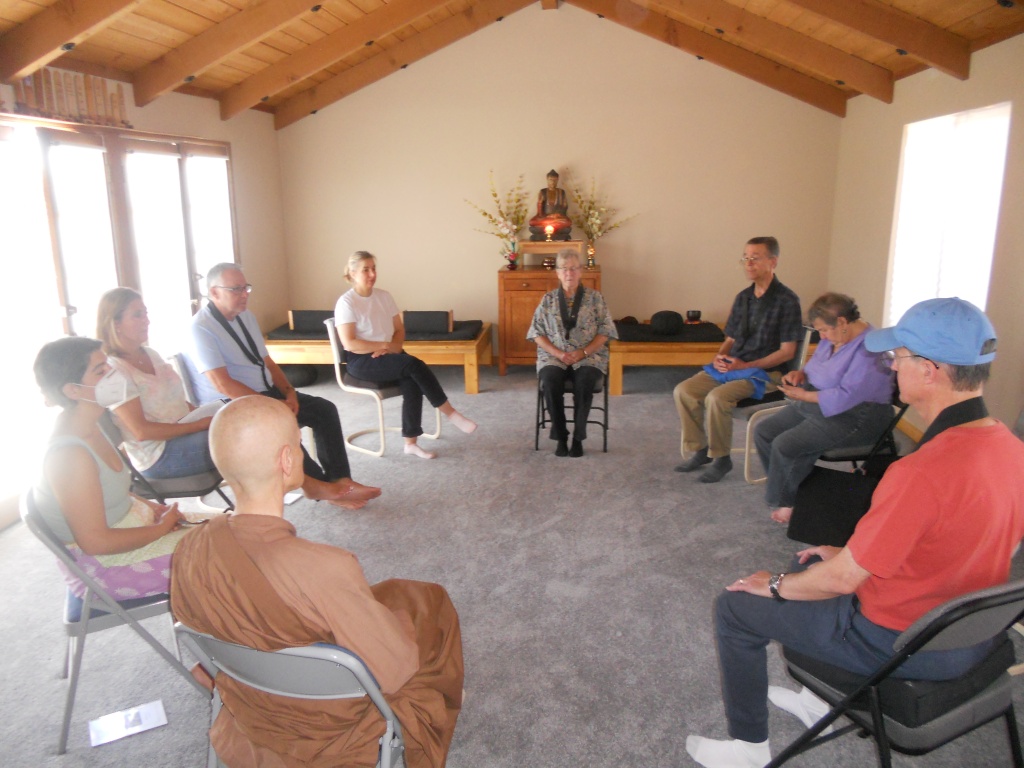
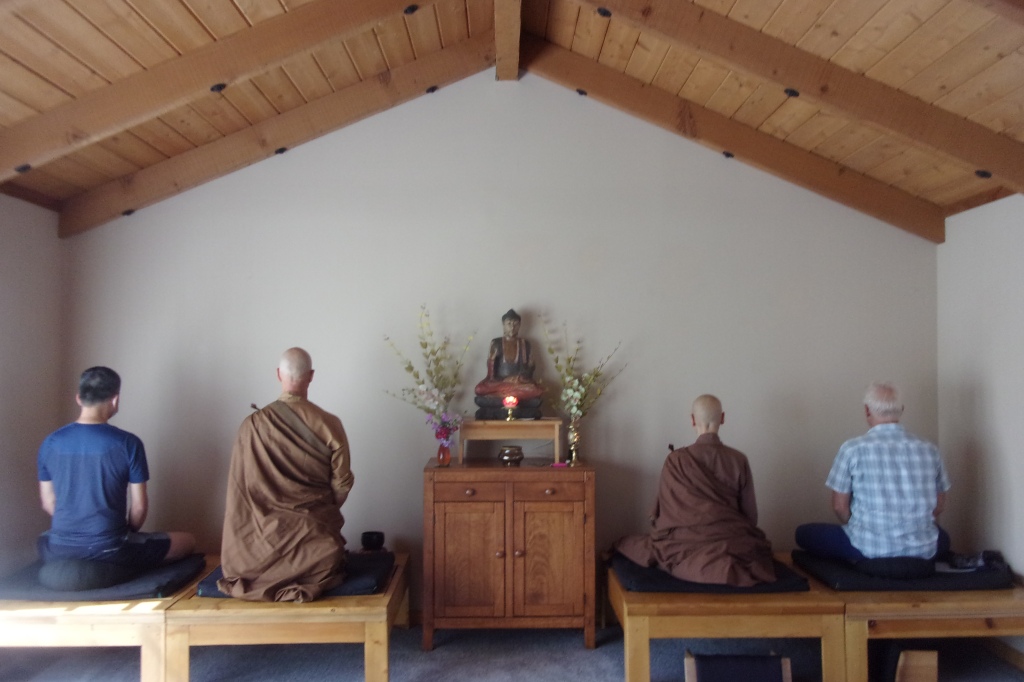

 Pine Mountain Buddhist Temple.